
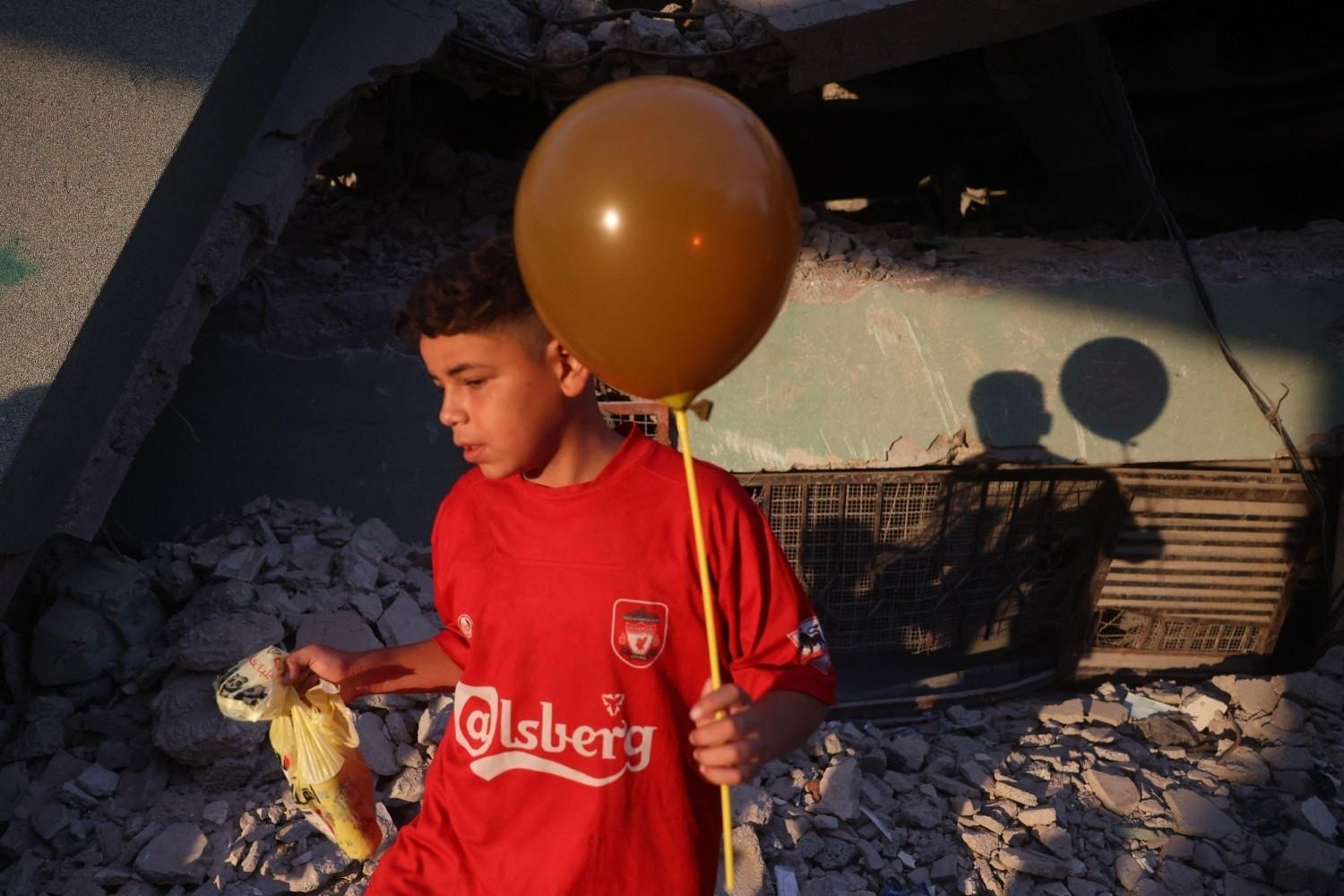
The shadow of a Palestinian boy holding a balloon is cast on the ruins of a destroyed building during morning prayers marking the start of Eid al-Adha, the Feast of Sacrifice, in Khan Yunis in the southern Gaza Strip on May 27, 2026. (AFP)
New clothes for children, sacrificial sheep and Eid biscuits, the hallmarks of the Muslim holiday, are all either unaffordable or unavailable in Gaza, casting a shadow over what is usually a time of celebration and joy.
“I go to the market only to look around because I cannot afford to buy anything. Whenever I ask about prices, I return heartbroken,” Nadia Abu Shamala, a Palestinian resident of Gaza, told AFP.
“This year, Eid comes with none of the joy we once knew in Gaza because of the effects of the war, the soaring prices, and our inability to provide even the simplest needs for our children,” said the 40-year-old woman from Gaza’s north displaced to the central Gaza city of Deir al-Balah for over two years.
Despite a U.S.-brokered ceasefire that began in October 2025, Israeli air strikes are still common in Gaza, where 80 percent of buildings were damaged in the war and most of the population depends on aid for basic needs, according to the United Nations.
Israel on May 27 killed the new head of Hamas’s armed wing in Gaza, Mohammed Odeh, after killing his predecessor earlier this month despite an ongoing ceasefire.
Israel controls all entry points to Gaza and lets trucks of foreign aid and private sector goods enter in numbers that are too low to bring down war-inflated prices or shortages, NGOs on the ground say.
“The truce is a big lie, but in any case, we are trying to create joy for the children,” said Abu Abdullah al-Mosadar, 59, who told AFP he pooled around 13,000 shekels ($4,570) with his brother to buy a sheep for sacrifice.
It is an amount that very few Gazans can afford.
“I know it is very expensive, but I decided to perform the sacrifice this year,” said Mosadar, a former property dealer from one of central Gaza’s well-established families, adding that he hopes to start his construction and real estate business when circumstances permit.
Central to Eid al-Adha celebrations, which mark the end of the Hajj pilgrimage to Mecca, is the sacrificing of a sheep.
But in tiny Gaza, livestock cannot enter from the outside, and only one quarter of the pre-war’s sheep population remains, or about 15,000 for the coastal territory’s 2.1 million inhabitants.
“Regarding prices this year, sacrificial animals are witnessing an unprecedented increase due to the limited supply and the rising costs of breeding, feed, and transportation, and the shutdown of many farms,” said Raafat Asaliya, spokesperson for Gaza’s Agriculture Ministry.
As a result, “a sheep or goat that was sold before the war for around 1,000 shekels is now priced between 11,000 and 15,000 shekels,” Asaliya said.


